


LCD and OLED are familiar to everyone, but what are the characteristics and differences between LCD and OLED? Let me take you to understand them together.
Firstly, the veteran of the screen industry - LCD screens
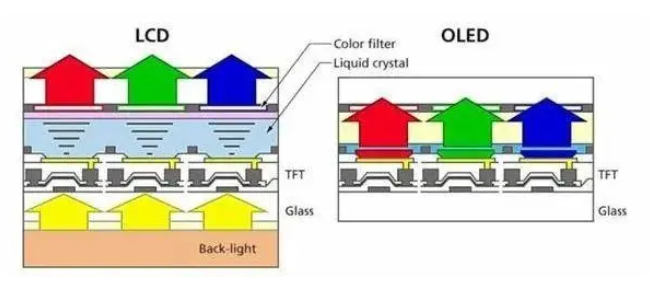
Simply put, an LCD screen is a liquid crystal display screen. This type of screen has a characteristic that OLED cannot replicate, which is that it cannot emit light on its own. Its screen display needs to be projected through a backlight panel to achieve the function of displaying content. This feature makes LCD screens display softer and emit more natural and gentle light compared to OLED screens, without causing strong irritation to the eyes. Even with long-term use of LCD screens, it is not easy to cause eye fatigue, and because the technology is more mature, the cost is lower.
The disadvantage is that eye protection is eye protection, but due to the need for a backlight panel to project light, smartphones with LCD screens require thicker space to install the backlight panel, resulting in thicker displays than OLED screens.
Secondly, the new dominant force in the screen industry - OLED screens
OLED screen refers to a screen made of organic light-emitting materials. Compared with LCD screen, its advantage is that it can self emit light without the need for background projection, and it has the advantages of being thinner and more operable than LCD screen. For example, current curved screens, perforated screens, and under screen fingerprint technology are all implemented under OLED screens. Moreover, due to the absence of backlight panels, OLED screens are more energy-efficient and efficient.

Of course, there are also drawbacks, which are that prolonged use can cause irritation to the eyes. Although OLED screen technology is constantly developing and eye protection functions are increasingly valued and optimized, overall it is still not as eye friendly as LCD screens.
The lifespan of OLED screens will be shorter than LCD screens, which means they will encounter the phenomenon of "burn-in" that we often refer to.
1. From the perspective of service lifeLCD screens use inorganic materials, while OLED screens use organic materials, which have a faster aging rate. Therefore,In terms of lifespan, LCD screens have advantages.
2. From a cost perspective.Compared to OLED screens,LCD screens have a longer history of development, more mature technology, and lower costs, which is why LCD screen phones are cheaper than OLED screen phones at the same level.
This is also the reason why mainstream commercial laptops still choose LCD screens. For commercial products of enterprises, stable performance is more important. Perhaps in the future, with the improvement of OLED screen lifespan and stability, it can be more widely used in commercial products for enterprises.
Overall, LCD screens and OLED screens have their own advantages and disadvantages, and they will coexist with each other for a long time. LCD screens have the advantages of mature technology, reliable quality, low price, and eye protection, but their scalability is not as good as OLED screens; OLED screens have strong adaptability to new technologies, but there are still issues such as flicker and burn-in that affect user experience waiting to be resolved.
If OLED screens are a player with unlimited potential, then LCD screens are also a player with stable performance. Overall, both have their own advantages and disadvantages, and it is difficult to determine who is stronger at this stage. Which would you choose between an LCD screen or an OLED screen?