


LCD is a display that uses liquid crystal as the material. Liquid crystal is a type of organic compound that exists between solid and liquid states. At room temperature, it exhibits both the fluidity of a liquid and the optical anisotropy of a crystal. When heated, it becomes a transparent liquid, and when cooled, it becomes a crystalline turbid solid.
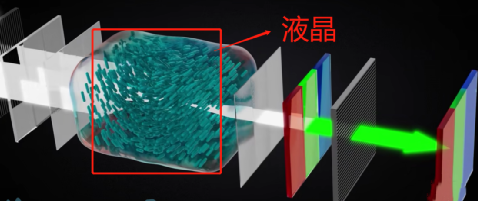
Under the action of an electric field, liquid crystal molecules undergo changes in arrangement, which affects the intensity of the incident light beam passing through the liquid crystal. This change in light intensity is further manifested as a change in brightness through the action of polarizing film. Based on this, the control of the liquid crystal electric field can achieve the brightness change of light, thus achieving the purpose of information display. Therefore, the function of liquid crystal materials is similar to small "light valves".
Due to the presence of control and drive circuits around the liquid crystal material. When the electrodes in the LCD generate an electric field, the liquid crystal molecules will twist, causing the light passing through them to undergo regular refraction (the optical rotation of liquid crystal materials), and then be filtered by the second layer of polarizer to be displayed on the screen.
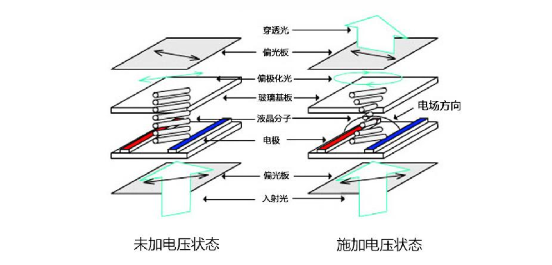
It is worth noting that liquid crystal materials do not emit light themselves, so LCDs usually require additional light sources to be configured for the display panel. The main light source system is calledBacklight moduleAmong them, the backlight panel is composed of fluorescent substances that can emit light,Its main function is to provide a uniform backlight source.
The cross-sectional view of the LCD is shown below,There are mainly 7 layers, from bottom to top are backlight layer, vertical polarizer, positive electrode circuit, liquid crystal layer, negative electrode circuit, horizontal polarizer, and color filter.
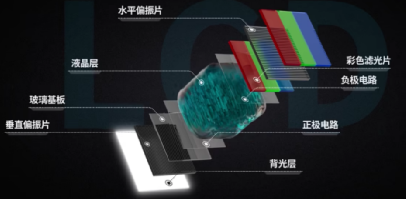
The function of the bottom backlight layer is to emit white light, which can be transformed into corresponding colored light after passing through colored filters.
Note: The backlight layer is not an independent LED bead below a pixel, but rather a large backlight layer shared by all pixels on the entire screen.
When we apply voltage to the positive electrode circuit, it penetrates the liquid crystal layer and connects to the negative electrode circuit to form a circuit. This voltage drives the liquid crystal layer to deflect, and at this time, the liquid crystal layer, like a shutter, blocks some of the light. At this point, we only need to control the magnitude of the voltage to regulate the deflection angle of the liquid crystal molecules, thereby controlling the brightness of the red, green, and blue sub pixels. By changing the brightness ratio, you can mix any color you want.
color display
For laptops or desktop LCDs, complex color displays are required.
For color LCDs, it is also necessary to have a specialized color filter layer for processing color displays, known as the "color filter" or "color filter film". In a color LCD panel, each pixel is typically composed of three liquid crystal cells, with red, green, or blue (RGB) three color filters in front of each cell. In this way, different colors can be displayed on the screen by lighting different cells.
Color filters, black matrices, and common transparent electrodes are generally deposited on the front glass substrate of the display screen. Color LCD can create colorful images in high-resolution environments.
Dynamic image display
The human visual organs (eyes) have a phenomenon called "visual residue" in their perception of dynamic images, which means that high-speed moving images will form brief impressions in the human brain. Early animated films and movies, as well as the latest gaming programs, have applied the principle of "visual residue" to quickly and continuously display a series of gradient images in front of people, forming dynamic images.
When multiple images are produced at a speed exceeding 24 frames per second, the human eye will perceive continuous images. This is also the origin of the movie's playback speed of 24 frames per second. If the display speed is lower than this standard, people will clearly feel the pause and discomfort of the screen. According to this indicator, the display time of each image needs to be less than 40ms. Fast moving images with high-definition display generally have a motion speed of over 60 frames per second. This means that the interval time between each frame of the moving image is 16.67ms.
If the response time of the LCD is greater than the interval time between each frame of the image, people will feel that the image is somewhat blurry when watching fast-moving images. Response time is a special indicator of LCD. The response time of LCD refers to the speed at which each pixel of the display responds to the input signal, which is the response time of the liquid crystal from "dark to bright" or from "bright to dark". The smaller the value, the better, as a fast response time is necessary to ensure the coherence of the image. If the response time is too long, it may cause the LCD to have a trailing effect when displaying dynamic images. The typical response time of LCD is 2-5ms.
TFT driver
The so-called TFT refers to the transistor array on the glass substrate of the LCD panel, which allows each pixel of the LCD to have its own semiconductor switch. Each pixel can control the liquid crystal between two glass substrates through point pulses, that is, independent and precise control of each pixel "point-to-point" can be achieved through active switches. Therefore, each node of the pixel is relatively independent and can be continuously controlled.
TFT LCD is mainly composed of a glass substrate, gate, drain, source, semiconductor active layer (a-Si), etc.
TFT arrays are generally deposited together with transparent pixel electrodes, storage capacitors, gate lines, signal lines, etc. on the rear glass substrate of the display screen (the substrate farther away from the display screen). The configuration of such a transistor array helps to improve the response speed of the liquid crystal display screen, and can also control the display grayscale, thereby ensuring that the image color of the LCD is more realistic and the picture quality is more pleasing to the eye. Therefore, most LCDs, LCD TVs, and some mobile phones are driven by TFT, whether it is small and medium-sized LCDs using narrow viewing angle twisted nematic (TN) mode, or large-sized LCD TVs (LCD-TV) using wide viewing angle parallel arrangement (IPS) mode, they are collectively referred to as "TFT-LCD".
IPS
IPS screen (In Plane Switching) technology is a liquid crystal panel technology introduced by Hitachi in 2001, commonly known as "Super TFT". IPS screen is a technology based on TFT, and its essence is still TFT screen. IPS solves the viewing angle problem by making molecules have the same apparent length in all directions.
The reason why IPS hard screens have clear and ultra stable dynamic display effects depends on their innovative horizontal conversion molecular arrangement, which changes the vertical molecular arrangement of VA soft screens and thus has a more robust and stable liquid crystal structure. Not in a superficial sense, a hard screen is a layer of hard protective film added to the LCD panel to prevent the LCD screen from being damaged by external hard objects.
As can be seen from the above, an LCD display screen is actually a liquid crystal display screen,Working principle of LCD monitorIt is formed by stimulating liquid crystal molecules with electric current to generate dots, lines, and surfaces, which are combined with the back light tube to form a picture.