


Nowadays, screens have become an indispensable part of people's lives. Whether it's computers, televisions, or smartphones, it's almost impossible not to look at screens for a day. Among the many display technologies around us, there is one that has been "glowing and heating up" since its birth in the 1980s,It is a liquid crystal display (LCD) screen.
1、 What is a LCD screen?
1Liquid Crystal Display, abbreviated as LCD in English, is a type of flat panel display.Used for screen display on televisions and computers. The advantages of this display screen are low power consumption, small size, and low radiation. The LCD display uses a liquid crystal solution in two polarizing materials, which causes the crystal to rearrange and achieve imaging when current passes through the liquid.
LCD displays use two polarizing materials with a liquid crystal solution between them. When current passes through the liquid, it will rearrange the crystals so that light cannot pass through them. Therefore, each crystal is like a louver, allowing light to pass through while blocking it.
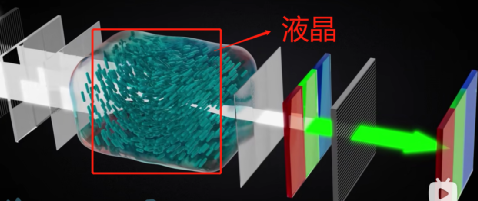
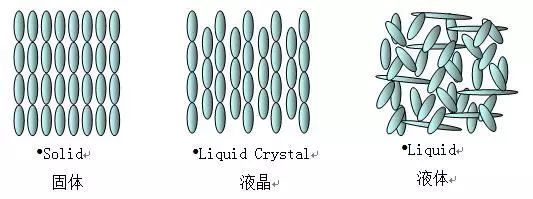
2. Liquid crystal is an organic compound that exists between solid and liquid (liquid when heated and crystallizes into a solid when cooled), with a regular arrangement of molecules, and does not emit light on its own.
3. Although the arrangement of liquid molecules does not have any regularity, if these molecules are elongated (or fan-shaped), their molecular orientation may have regularity. So, the liquid can be further divided into many forms. Liquids with irregular molecular directions can be directly referred to as liquids, while liquids with directional molecules are called liquid crystals, also known as liquid crystals.
2、 Optical effects of liquid crystals
Liquid crystal is contained in the middle of two groove shaped surfaces, and the directions of the grooves are perpendicular to each other, as shown in the figure below. The polarization directions of the polarizing plates on the upper and lower surfaces are perpendicular to each other. The arrangement of liquid crystal molecules is: the upper surface is longitudinal, and the lower surface is transverse. The molecules in the middle of the upper and lower surfaces produce a rotational effect, so the liquid crystal molecules rotate 90 º between the two groove shaped surfaces.

When linearly polarized light enters the upper grooved surface, this light also rotates with the rotation of the liquid crystal molecules; When linearly polarized light exits the lower grooved surface, it has already undergone a 90 º rotation. When a voltage is applied between the upper and lower surfaces, liquid crystal molecules will align in the direction of the electric field, forming an upright arrangement. At this point, the incident light is not affected by the liquid crystal molecules, and the straight line cannot exit the lower surface. Different voltage values determine the angle of liquid crystal deflection.
3、 The working principle of LCD display screen
The working principle of a liquid crystal display screen is to utilize the physical properties of the liquid crystal (i.e., the arrangement of liquid crystal molecules changes under the action of an electric field, making the arrangement orderly when powered on, making it easy for light to pass through; when not powered on, the arrangement is chaotic, preventing light from passing through). The liquid crystal is placed between two conductive glass substrates, and the electric field effect between two transparent electrodes causes the liquid crystal molecules to twist and align. Under the control of power on and off, it affects the transmittance or reflectivity of its liquid crystal cells, thereby controlling the light source transmission or shielding function. Based on this principle, each pixel is controlled to produce images with different gray levels and colors.
Liquid crystals are divided into two categories: lyotropic liquid crystals and thermochromic liquid crystals; As a display technology application, liquid crystals are all thermally induced liquid crystals.
4、 Structure of TFT-LCD Liquid Crystal Display Screen
The structure of a TFT-LCD liquid crystal screen is mainly composed of seven layers, from the inside out. The bottom backlight layer is responsible for emitting light, the front color filter forms the color that our human eyes finally see, and the middle black technology part is the liquid crystal. It is composed of backlight, polarizer, transparent electrode (control circuit), liquid crystal, color filter, and polarizer in sequence.
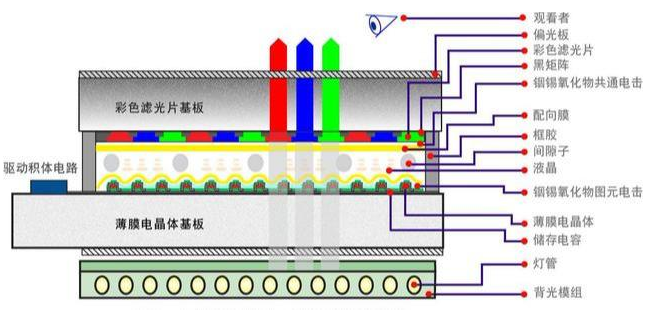
LCD display screen structure
Liquid crystal itself does not emit light, but it can change the direction of light. Under the action of an electric field, the liquid crystal will rotate. Depending on the rotation angle, the brightness of the light passing through the front polarizer will also vary, ultimately resulting in a mixture of ever-changing colors.
4、 The LCD screen combines rich color principles
Screens usually use internal LEDs as light sources, emitting white light. Therefore, we know that white light is composed of multiple light waves of different frequencies. So we can get the color we want through the filter film. Although there is a certain range of visible light wavelengths for each color, we do not need to represent each wavelength of color separately when processing colors. Because all colors in nature can be obtained by combining different intensities of the wavelengths of red, green, and blue (RGB), which is commonly known as the three primary color principle. Therefore, these three types of light are often referred to as the three primary colors or the three primary colors. By filtering out these three colors through a filter film, and then adjusting the angle of liquid crystal flipping by changing the driving voltage, the amount of light passing through RGB sub pixels can be changed, and rich color expression can be obtained through the principle of additive color mixing.

RGB three primary colors