


LCD display is currently the most widely used human-computer interaction interface in the market, widely used in mobile phones, smart wearables, instruments, and smart TVs. It can be said that wherever a display is needed, a certain type of LCD display may be used. Here is a brief introduction to the basic structural characteristics of LCD liquid crystal display devices.
A typical LCD display device is composed of a polarizing plate, polarizing film, front and rear glass substrates, LCD display screen, light-emitting diode, etc. Its basic structure is a flat panel type and belongs to the category of flat panel display devices.
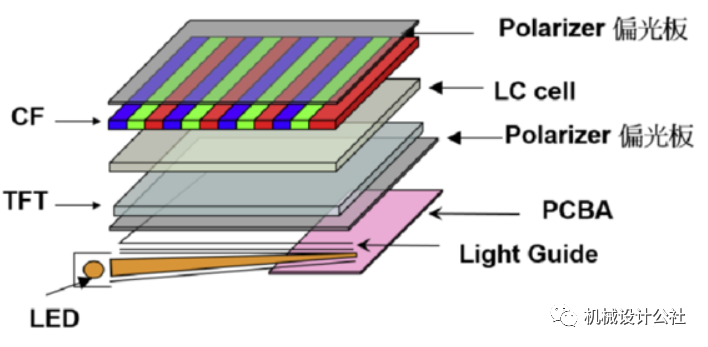
LCD display devices have three basic components, namely glass substrate, liquid crystal material, and polarizer.
1) Glass substrate
A glass substrate has an extremely flat surface, on which a transparent conductive layer of In2O3 or SnO2 (ITO) is evaporated. Through photolithography, a transparent conductive pattern composed of pixel patterns and external lead patterns is formed. The external leads of the glass substrate need to be connected through conductive rubber, which cannot be achieved by traditional soldering methods. During the production and storage process of glass substrates, it is necessary to avoid damage such as corrosion, cutting, or scratching, which can cause permanent damage to the display device.
2) Liquid crystal material
Liquid crystal materials are the elements that enable display functions and are the main components of liquid crystal display devices. Liquid crystal materials are generally mixed with different types of monomeric liquid crystal materials, and are proportioned according to the different functions of the devices used. Each monomer liquid crystal material has its fixed clear point temperature TL and crystallization temperature TS. Therefore, it is necessary to require each LCD display screen to be used or stored within a certain temperature range between TS and TL. If the temperature used or stored is too low, the crystallization will damage the orientation layer of the LCD display screen; If the temperature is too high, the LCD will lose its liquid crystal state, thus losing all the functions of the LCD display screen.
3) Polarizing film
Polarizers are made of plastic film material. The polarizing film is coated with optical pressure-sensitive adhesive, which adheres to the surface of the liquid crystal cell. The properties of polarizing film will change with temperature and humidity. Storing polarizing film under high temperature and humidity can cause depolarization or foaming of polarizing film, making it unable to adhere to the surface of the liquid crystal cell.