


Liquid Crystal Display (LCD) is a display technology widely used in various electronic devices.It utilizes the characteristics of liquid crystal materials to control the passage of light, thereby forming images on the screen.

1、 Here are some basic characteristics and applications of LCD screens:
1. Working principle: The liquid crystal molecules in the LCD display can change their arrangement under the action of an electric field, thereby controlling the propagation of light. When light passes through the liquid crystal layer, the arrangement of liquid crystal molecules affects the polarization state of the light, thereby controlling the brightness of the light.
2. Backlight source: Most LCD displays require a backlight source to provide light. Backlights are usually LEDs or CCFLs (cold cathode fluorescent lamps), which emit light that passes through liquid crystal layers and color filters to form color images.
3. Resolution: The resolution of a LCD screen refers to the number of pixels that can be displayed on the screen, usually expressed as horizontal pixels multiplied by vertical pixels, such as 1920x1080.
4. Refresh rate: Refresh rate refers to the number of times the display screen updates the image per second, usually measured in hertz (Hz). A high refresh rate can reduce motion blur and make dynamic images smoother.
5. Color performance: The color performance of LCD screens depends on the color filters and backlight sources used. High quality LCD displays can provide a wide color gamut and accurate color reproduction.
6. Application areas: LCD screens are widely used in various devices such as televisions, computer monitors, mobile phones, tablets, digital cameras, and car displays.
7. Energy saving: Compared to traditional CRT (cathode ray tube) displays, LCD displays are more energy-efficient because they only consume power in the areas where images need to be displayed.
8. Environmental impact: LCD screens do not contain harmful substances such as lead and mercury, so their impact on the environment is relatively small.
With the development of technology, LCD displays are also constantly advancing, such as the emergence of thinner, lighter, and more energy-efficient OLED (Organic Light Emitting Diode) displays. They do not require a backlight source, and each pixel can emit light on its own, providing higher contrast and a wider viewing angle.
2、 There are several types of backlight sources for LCD displays, each with its own unique advantages and disadvantages:
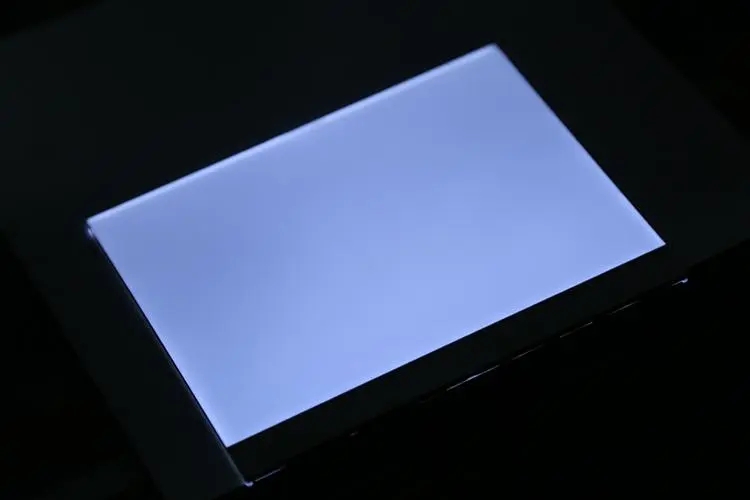
CCFL (cold cathode fluorescent lamp) backlight:
Advantages: Low cost, stable color, and long lifespan.
Disadvantages: Large size, high power consumption, high heat generation, poor brightness uniformity, and containing harmful substances such as mercury.
LED (Light Emitting Diode) Backlight:
It is divided into two designs: direct bottom lighting and edge lighting.
Advantages: Low power consumption, long lifespan, high color accuracy, can be made thinner, environmentally friendly and mercury free.
Disadvantage: The initial cost is relatively high, but as technology advances, the cost gradually decreases.
OLED (Organic Light Emitting Diode) Backlight:
Advantages: Self luminous, no need for backlight, thinner and lighter, high contrast, fast response time, wide viewing angle, low power consumption.
Disadvantages: High cost, relatively short lifespan, and susceptibility to environmental influences.
QLED (quantum dot light-emitting diode) backlight:
Advantages: High color accuracy, wide color gamut, and high brightness.
Disadvantages: High cost, relying on LED backlight technology.
EL (Electro Luminescence) Backlight:
Advantages: Extremely thin, lightweight, providing uniform light.
Disadvantages: It requires an inverter to provide high voltage and has a limited lifespan, usually between 3000 to 5000 hours.
MiniLED backlight:
Advantages: Compared to traditional LED backlighting, miniLED provides more localized dimming areas, improving contrast and display quality.
Disadvantages: High cost and relatively new technology.
MicroLED backlight:
Advantages: high brightness, high contrast, fast response, long lifespan, no screen burn-in issues.
Disadvantages: Currently, the technology is not fully mature and the production cost is high.
When choosing a backlight source, it is necessary to make a suitable choice based on the product's requirements and specific application environment.For professional applications that require high brightness and color accuracy, OLED or QLED backlighting may be chosen; For applications that pursue energy efficiency and long lifespan, LED backlighting may be a better choice. With the continuous development of technology, backlight technology is also constantly advancing, providing users with a better visual experience.