


What are LCD, LED, OLED, QLED, miniLED, and even microLED, and what are their differences? These terms are particularly confusing when we choose display screen modules, and today we will explain them in detail here.
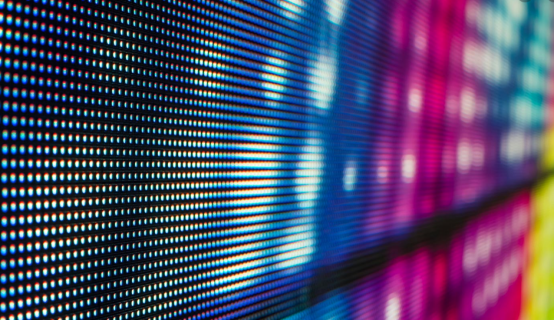
LCD
LCD is the full name of Liquid Crystal Display, which mainly includes several types of LCD displays such as TFT, UFB, TFD, STN, etc.
The structure of an LCD is to place a liquid crystal cell between two parallel glass substrates, with a TFT (thin film transistor) on the lower substrate glass and a color filter on the upper substrate glass. The rotation direction of the liquid crystal molecules is controlled by the signal and voltage changes on the TFT, thereby achieving the display purpose of controlling whether each pixel emits polarized light or not.
LCD is a substance between solid and liquid states, which cannot emit light on its own and requires additional light sources. Therefore, the number of light tubes is related to the brightness of the LCD display.
LED
LED (Light emitting diode) screens, in fact, the images of these displays are still generated by liquid crystal. LEDs are only used as light sources and are technically still LCD displays, or LED backlit LCD TVs.
The advantages of LCD TVs with LED screens include small size, low power consumption, long lifespan, low cost, high brightness, long viewing angle, and high refresh rate. However, the disadvantage is poor color performance, especially in areas where the LCD screen is folded, where color deviation is more pronounced.
OLED
OLED (Organic Light Emitting Diode) is an organic light-emitting diode that, although only one letter different from LED, actually describes completely different things.
We all know that liquid crystal panels emit light through a backlight source and produce various colors through the refraction of liquid crystal molecules. Liquid crystal molecules themselves cannot emit light, while LED only refers to the backlight source.
OLED, on the other hand, is capable of emitting light on its own, so it does not require a backlight source. LEDs use metal materials, while OLEDs use organic materials. They can emit light independently without the need for lighting, resulting in better contrast. LEDs used in daily life require backlighting to see things.
At present, the materials used in light-emitting diodes are all inorganic semiconductor materials, which are difficult to apply to large areas and require high-resolution components (EX: screens). To solve these problems, new organic semiconductor materials (i.e. materials containing hydrocarbons) need to be used. By coating them on conductive glass sheets and passing current, various wavelengths of light can be emitted.
QLED
QLED stands for Quantum Dot Light Emitting Diodes, which is a self luminous technology that does not require an additional light source.
Quantum dots are extremely small semiconductor nanocrystals that are invisible to the naked eye and are particles with a size of less than 10 nanometers. Quantum dots have a unique characteristic: whenever stimulated by light or electricity, they emit colored light. The color of the light is determined by the materials and size of the quantum dots, and its frequency can be precisely adjusted by changing the size, shape, and material of the quantum dots, thus achieving various applications.
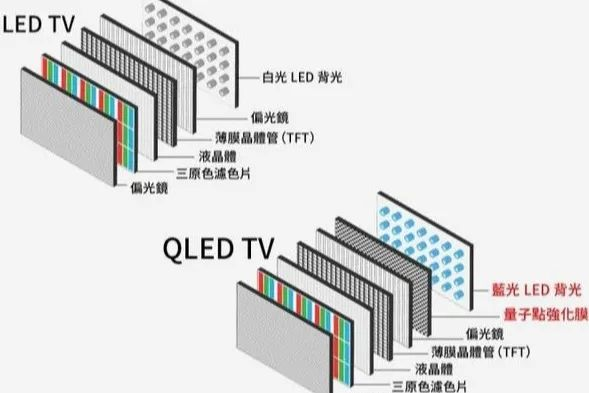
The structure of QLED is very similar to OLED technology, with the main difference being that the luminescent center of QLED is composed of quantum dots. Its structure is that electrons and holes on both sides converge in the quantum dot layer to form photons (Exciton), and emit light through the recombination of photons.
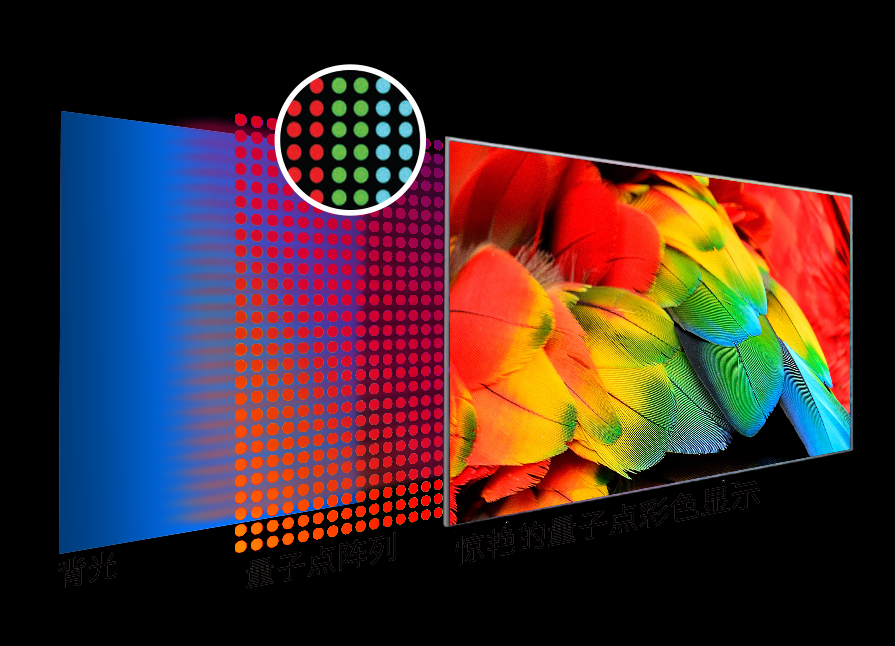
Mini LED
Mini LED technology can be directly used for RGB display or for LCD backlight modules. In the LCD screen backlight module, the display effect is mainly improved by using Mini LED technology.
The principle of its MiniLED technology is that Mini LED adopts a direct backlight method, which can be seen as an upgraded version of a regular LCD screen. Mini LED reduces the size of traditional LED backlight beads, achieving more precise and dense backlight partitioning. Combined with local dimming control, it improves brightness and contrast, enhancing visual perception. Under the same conditions of comparison, Mini LED not only compensates for the disadvantage of OLED being prone to burn-in, but also has a cost advantage over OLED, improving the image quality while also having a cost advantage.
microLED
Finally, there is microLED. The biggest difference between it and OLED is the luminescent material. OLED uses organic thin films, while microLED is inorganic micro light beads.
Its predecessor was the type of outdoor large advertising wall. The dot matrix composed of inorganic light-emitting diodes looks fine from a distance, but up close, they are really small light bulbs with a strong graininess.
So the technological breakthrough of microLED is to further miniaturize these small light bulbs. Due to different material properties, it has a longer screen lifespan than OLED. But the disadvantage is that the production process is much more complex, and the price will naturally be higher.
To sum up, LCD, OLED, and microLED, these three screen technologies represent three different technological schools. MicroLED has not yet been mass-produced, OLED is the representative of mobile phone screens, and LCD is the mainstream of TV and computer monitors, with a clear distinction at present.
As for miniLED and QLED, in the consumer market, they are essentially LCD liquid crystals, but they adopt different technical solutions in the backlight module.
Now you know that when selecting LCD screen modules, you can distinguish between LCD, LED, OLED, QLED, miniLED, and microLED, right.