


Have you also encountered this situation before?
The customer came to select the product, and once the parameter table was opened, more than ten data items such as size, resolution, refresh rate, interface, color gamut, etc. were densely packed.
You know in your heart that 180Hz is smoother than 144Hz, and 2K is clearer than 1080P. But the customer asked a question:How much is the price difference between these two
After you quoted the price, the customer fell silent.
You feel a chill in your heart,I'm stuck on the 'price' again.
We are too familiar with this scene.
Having been in the display industry for so many years, what we are afraid of is not that our customers do not understand the parameters,But the product has differentiation, but I don't know how to talk about it in the hearts of customers.
We have carefully studied itThe esports display market in 2026Real data reveals something,The customer doesn't buy, it's not because they are too expensive, it's because you didn't show them the 'value'.
Where exactly is this' value '?
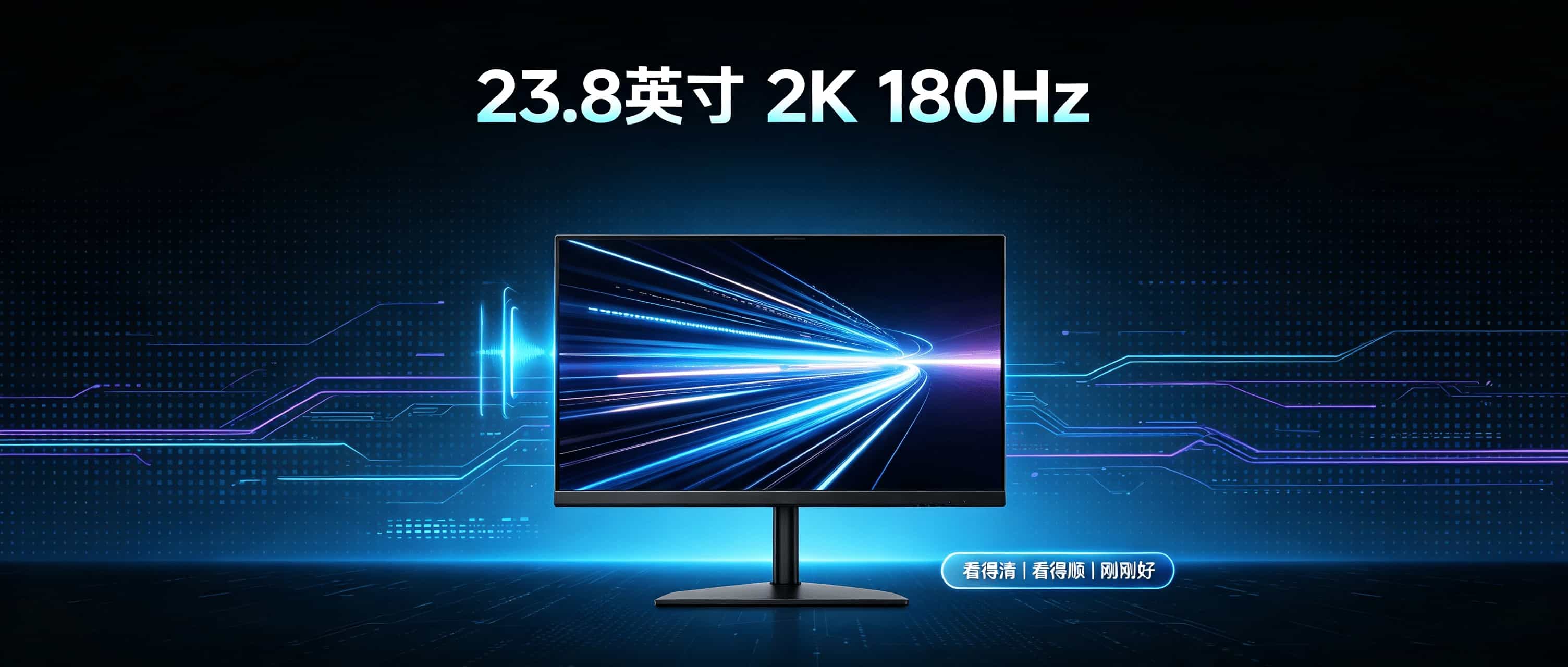
1、 Why 23.8 inches 2K 180Hz?
Let's talk about resolution first.2560× 1440, which is commonly referred to as 2K. On a size of 23.8 inches, the pixel density (PPI) is approximately 123.
What concept? The PPI for 1080P of the same size is only 92.There is a full 30% increase in pixel density.
This means that the font edges are sharper, the distant details in the game are clearer, and the lines no longer have jagged edges when designing. In one sentence:You can see clearly, but look closely.
Let's talk about the refresh rate.180Hz, Refresh 180 frames per second. Compared to 60Hz,The fluency has increased by a full three times.
In FPS games, quick turns do not drag shadows, in racing games, the scenery on the roadside does not become blurred, and in MOBA games, no matter how many team battle effects there are, frames will not drop.
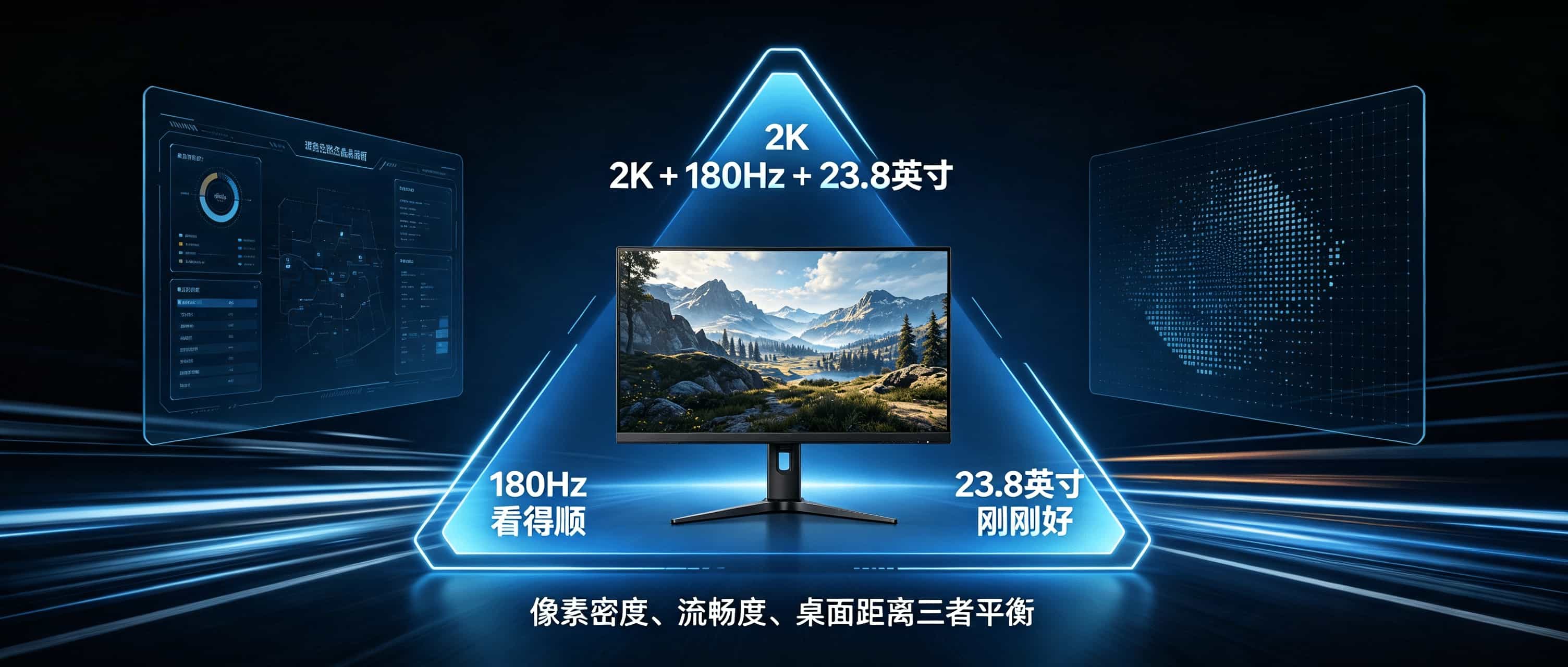
2K is responsible for "clear viewing", and 180Hz is responsible for "smooth viewing".One solves the picture quality, the other solves the smoothness, put the two together,This is called 'experience upgrade'.
Next, let's talk about the size.23.8 inches, there are specific requirements for this size. It doesn't require turning the head to look at the corners like 27 inches, and it has a larger field of view than 21.5 inches.
The desktop depth of the vast majority of esports players (60-80cm) is just right for this size. Not big or small, just right.
That's also why 23.8 inches have always held an important position in the esports display market.
2K resolution 180Hz refresh rate 23.8-inch size,This combination is called the "golden triangle" of esports displays, and it makes sense.
2、 23.8-inch 2K 180HZ module during the competition
Let's take a look at the specific parameters:
Size: 23.8 inches
Resolution: 2560× 1440(2K)
Refresh rate: 180Hz
Color gamut: 72% NTSC
Color depth: 8-bit
Interface: LVDS
Working temperature: 0~50 ℃
Form: Supports Bent (bending/curved)
Model: CSOT/SG2381G01-3
A few points worth discussing:
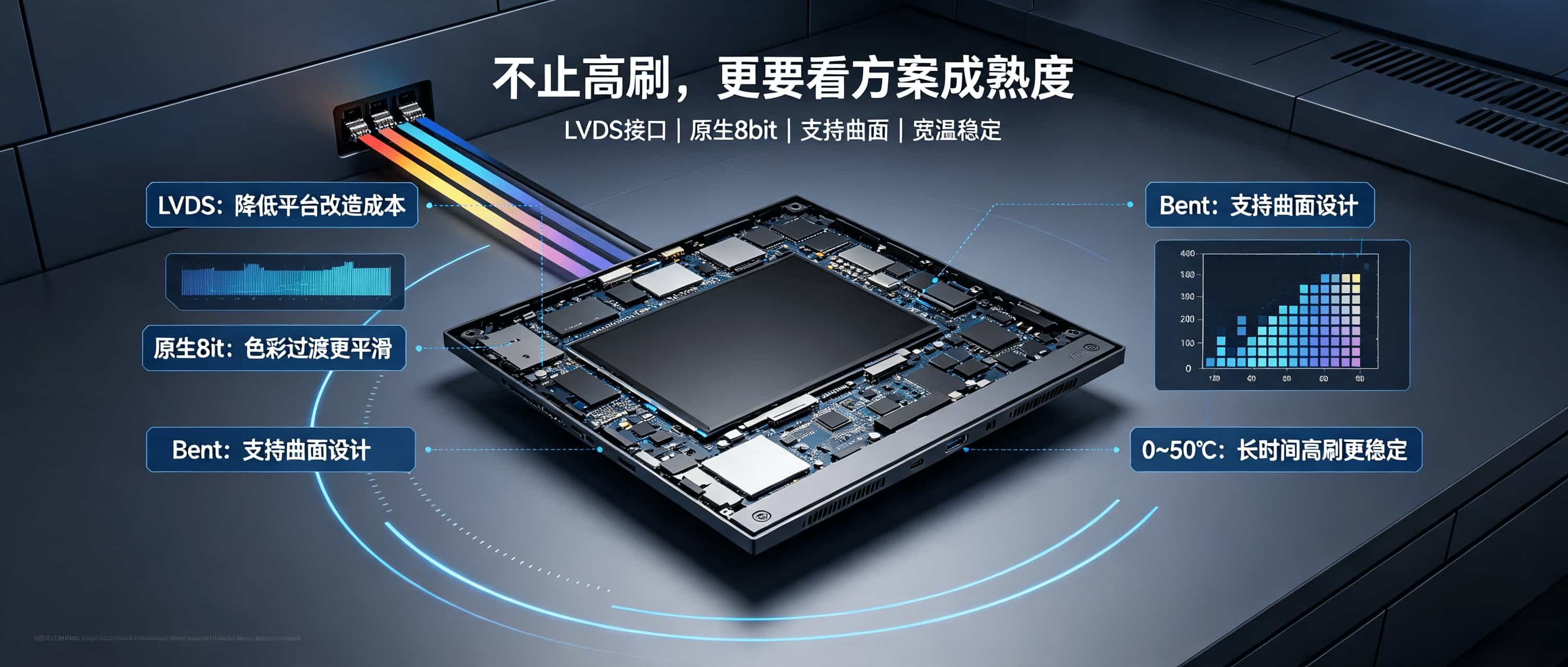
1. What does LVDS interface mean for manufacturers of complete machines?
Many high refresh rate modules on the market must use eDP interfaces in order to run high bandwidth. But eDP means that the main control solution needs to be changed accordingly. For many mature product lines, changing interfaces is equivalent to changing platforms, and time and cost cannot withstand it.
The 23.8-inch Saishida uses an LVDS interface.As long as the main control scheme itself supports 180Hz signal output, customers do not need to make major changes to the existing scheme,Upgrading from 60Hz to 180Hz can be achieved by directly replacing the module.For brand owners,This is a real 'cost reduction and efficiency improvement'.
2. 8-bit True Color Depth, Not 6 Douyin 8
Some high refresh rate modules use 6-bit FRC (jitter to 8-bit) to reduce costs. The color transition is calculated by algorithms, not real.The Saishida model uses native 8-bit technology, with smoother color transitions and no "circle by circle" color level discontinuity.
The same 8-bit, the difference between native and jitter is visible to the naked eye.
3. Support Bent surface design
The market demand for curved gaming screens has been on the rise. This module supports Bent bending technology. Customers who want to make curved displays can directly develop based on this module without having to find a separate curved solution.
4. Working temperature of 0-50 ℃, covering the vast majority of usage scenarios
It is common for esports players to spend several hours playing a game, and the issue of monitor overheating cannot be avoided.The working temperature range of 0-50 ℃ ensures stability during long-term high brush operation.
3、 3 suggestions for monitor brands
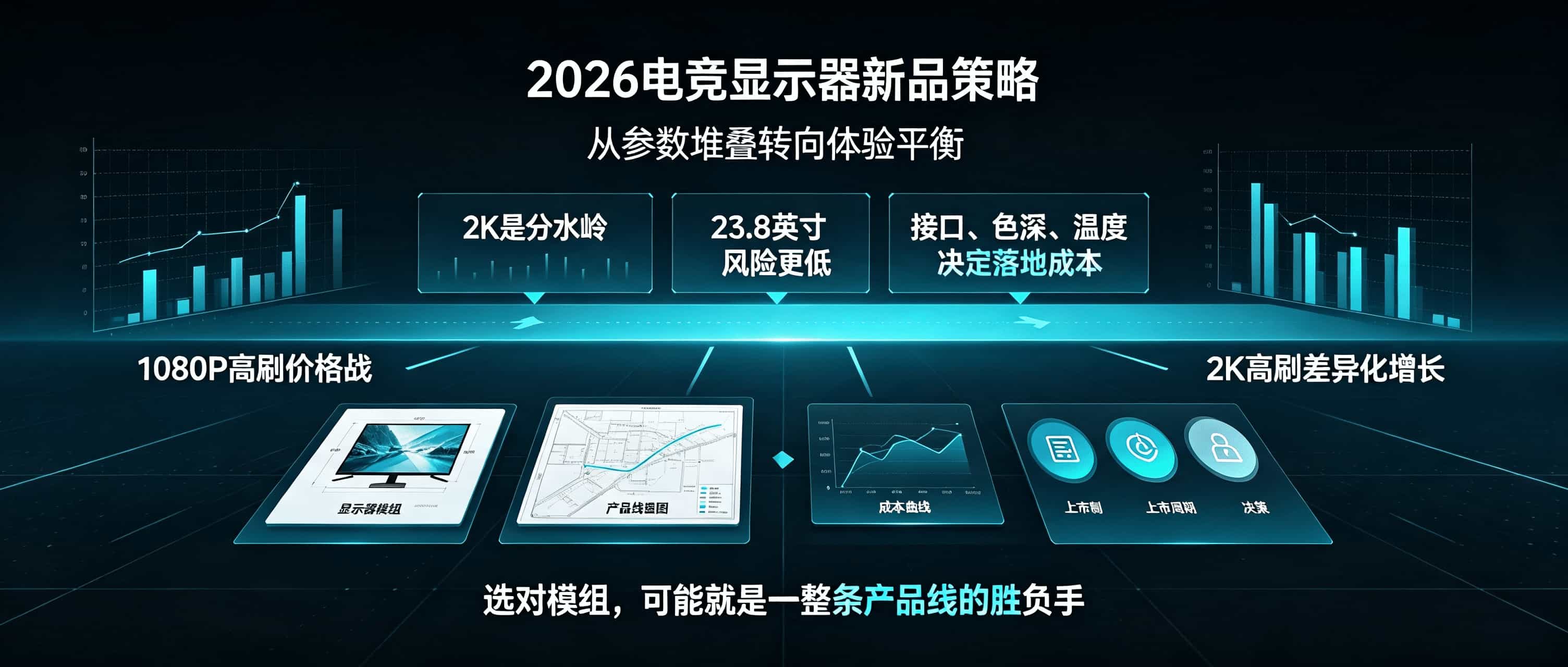
Firstly, in 2026, 2K will be the watershed for making esports displays.1080P high refresh rate has become a price war, with profits as thin as paper.
2K high refresh rate is the direction of differentiated competition. Consumers are willing to pay for 'seeing clearly and smoothly',This has been repeatedly verified in the market data of the past two years.
Secondly, 23.8 inches is a size that is "less prone to errors".It covers a wide range of people, from college dormitories to company workstations, from home study rooms to e-sports internet cafes, this size is universal.
If your product line only produces one size of esports monitor,Choosing 23.8 inches is a low-risk option.
Thirdly, when selecting a module, don't just look at the refresh rate as a single number.The interface scheme, color depth, operating temperature, and support for curved surfaces are not only parameters that determine product performance, but also your research and development costs and market cycle.
Saishida provides a one-stop module solution, from selection to sampling to mass production, with full support throughout the entire process.
There is an interesting phenomenon in the display industry,The cycle for consumers to replace their monitors is getting shorter and shorter.
I used to use a monitor for five or six years without replacing it, but now I want to upgrade it after two or three years. Why? Because the technological iteration is too fast.
60Hz to 144Hz is one wave, and 144Hz to 180Hz is another wave.Every upgrade brings an experience improvement that cannot be returned after use.
23.8-inch 2K 180Hz, I dare not say it is the end of esports displays,But at least by 2026, it is a balanced, mature, and not easily bought wrong plan.
For display brands, choosing the right module may be the winner of the entire product line.
If you are planning a new esports monitor for 2026,Let's take a look at this 23.8-inch 2K 180Hz module.
Parameters can be stacked, but the experience cannot deceive people.
If you are interested in this 23.8-inch 2K 180Hz module,Welcome to leave a message for the 180Hz sample or contact us,Obtain detailed specifications and sample support. A one-stop solution for LCD display modules ranging from 10.1 "to 32" during the competition. )
#Esports monitor # 2K monitor # 180Hz # High refresh rate monitor # 23.8 inches # Fast IPS # Monitor recommendation # Esports equipment # LCD module # Monitor upgrade