


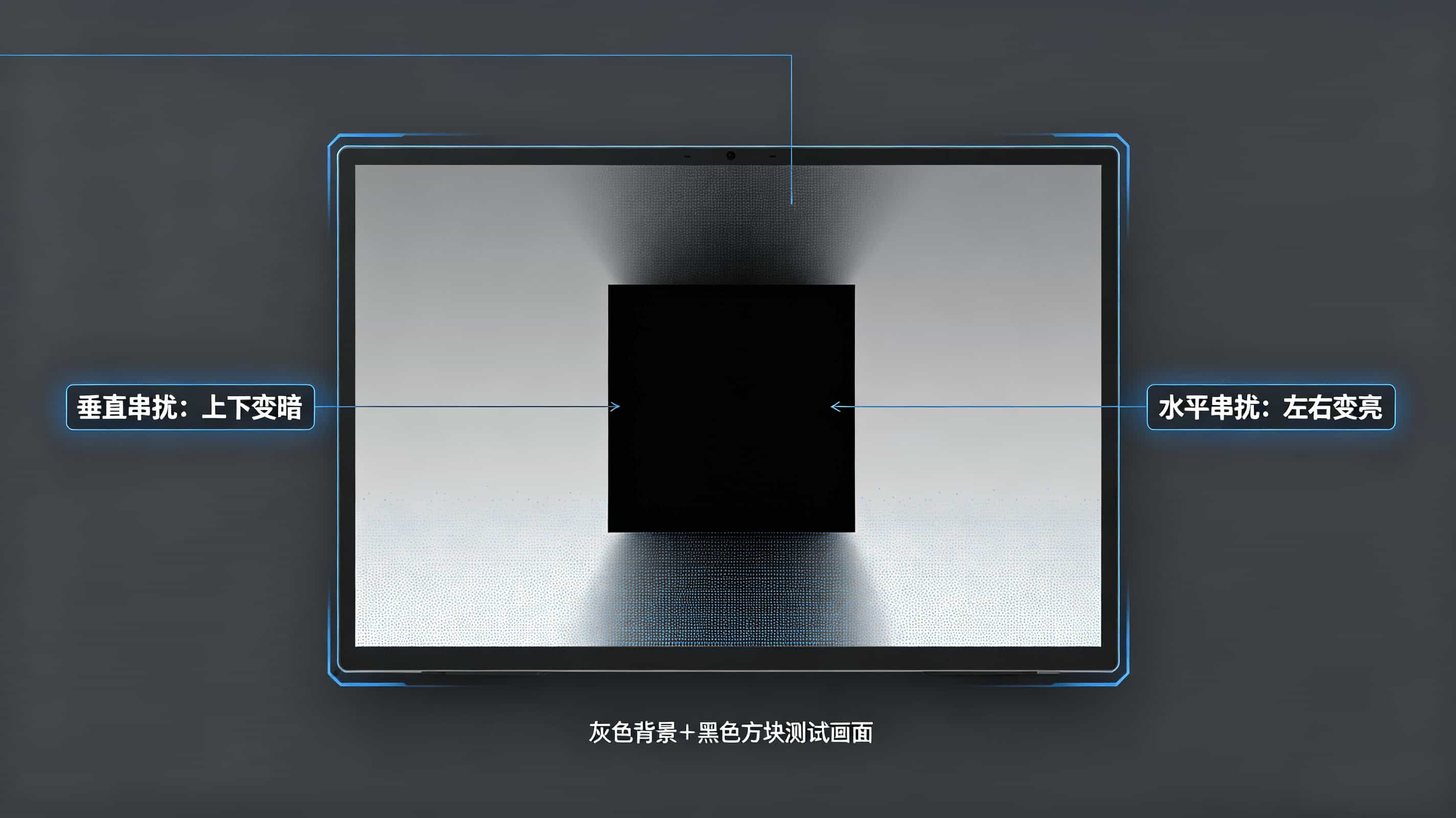
Have you ever encountered a situation where a black square is displayed in the middle of a gray background on a monitor or advertising machine screen, and the area around the square inexplicably brightens or darkens?
This is not a broken screen, but a common LCD display phenomenon,It's called Crosstalk.
If you are working on monitors, laptops, advertising machines, or terminal devices, this article is written for you.
We won't pile up jargon, make it clearWhat is crosstalk, how does it come about, and how can it be avoided,Help you avoid detours and avoid bearing the responsibility of after-sales service.
1、 What exactly is crosstalk? What does it mean for end products?
Simply put,crosstalkIt is when a certain area of the screen is disturbed by signals from another area, causing areas that should not be bright to become bright and areas that should not be dark to become dark.
A common situation is to place a black square in the middle of a gray background, and the upper and lower areas of the square become darker(Vertical crosstalk)The left and right areas become brighter(Horizontal crosstalk).
Doesn't it sound like a big deal? Then you underestimate it.
For terminal manufacturers, crosstalk means three things:
Firstly, quality control overturned.Your product was not discovered when it left the factory, but it was exposed as soon as it was powered on by the customer. Especially in some scenarios that require high display quality, such as design displays, medical terminals, and car screens, crosstalk is a fatal injury.
Secondly, the cost of after-sales service has skyrocketed.A screen has a problem, customers come to you, you go to the supplier, back and forth pulling, returning and exchanging goods, shipping costs, and working hours are all real money.
Thirdly, the brand reputation is damaged.End users do not understand what crosstalk is, they only know that 'this screen looks uncomfortable'. A negative review posted online, or a buyer show with a picture feedback, not only results in a loss of business.
So, the issue of crosstalk has to be nipped in the bud during the module selection stage.
2、 How does crosstalk come about? Two culprits
There are two types of crosstalk: vertical crosstalk and horizontal crosstalk,The causes are quite different.
Vertical crosstalk (darkening of upper and lower areas), mainly due to two reasons:

One reason is that the parasitic capacitance (Cpd) between the data line and the pixel electrode is too large. To put it simply, the signal lines are too close to each other, causing them to 'string signals' with each other.
The 8K panel has four times more pixels than the 4K panel, but the storage capacitor has decreased by about 80%. The pixel voltage fluctuates slightly, and the display difference is very obvious.
The second issue is that the off state leakage current (Ioff) of the TFT is too high. That is to say, the switch that should have been turned off was not tightly closed and leaked electricity.When it should be turned off, it was not tightly closed, and the current leaked, causing pixels that should not be lit to also light up.
Horizontal crosstalk (brightening of left and right areas) is mainly related to the high resistance of COM-ITO.Simply put, the common electrode resistance of the screen is too high, and the voltage cannot return, so it is strung to the side.The common electrode on the upper board is essentially an RC delay network. If the resistance is high and the voltage cannot recover to the set value, crosstalk will occur.
Furthermore,Insufficient signal isolation of the driver IC, poor power filtering, FPC bending stress, and internal electromagnetic interference of the entire machine may all induce or exacerbate crosstalk.
And you may not believe it if you say it,Sometimes crosstalk is not a problem with the screen itself, but rather caused by the assembly process of the entire machine.
Incorrect bending angle of FPC cable and inadequate internal electromagnetic shielding may damage a good screen.No matter how good the module is, it's useless if you don't pay attention to assembly.
3、 The good news is that crosstalk can be controlled
There are standards for crosstalk in the industry. Our requirements in the Hatter/Ares project areCrosstalk < 1.5%More stringent than the 3% standard of many peers.
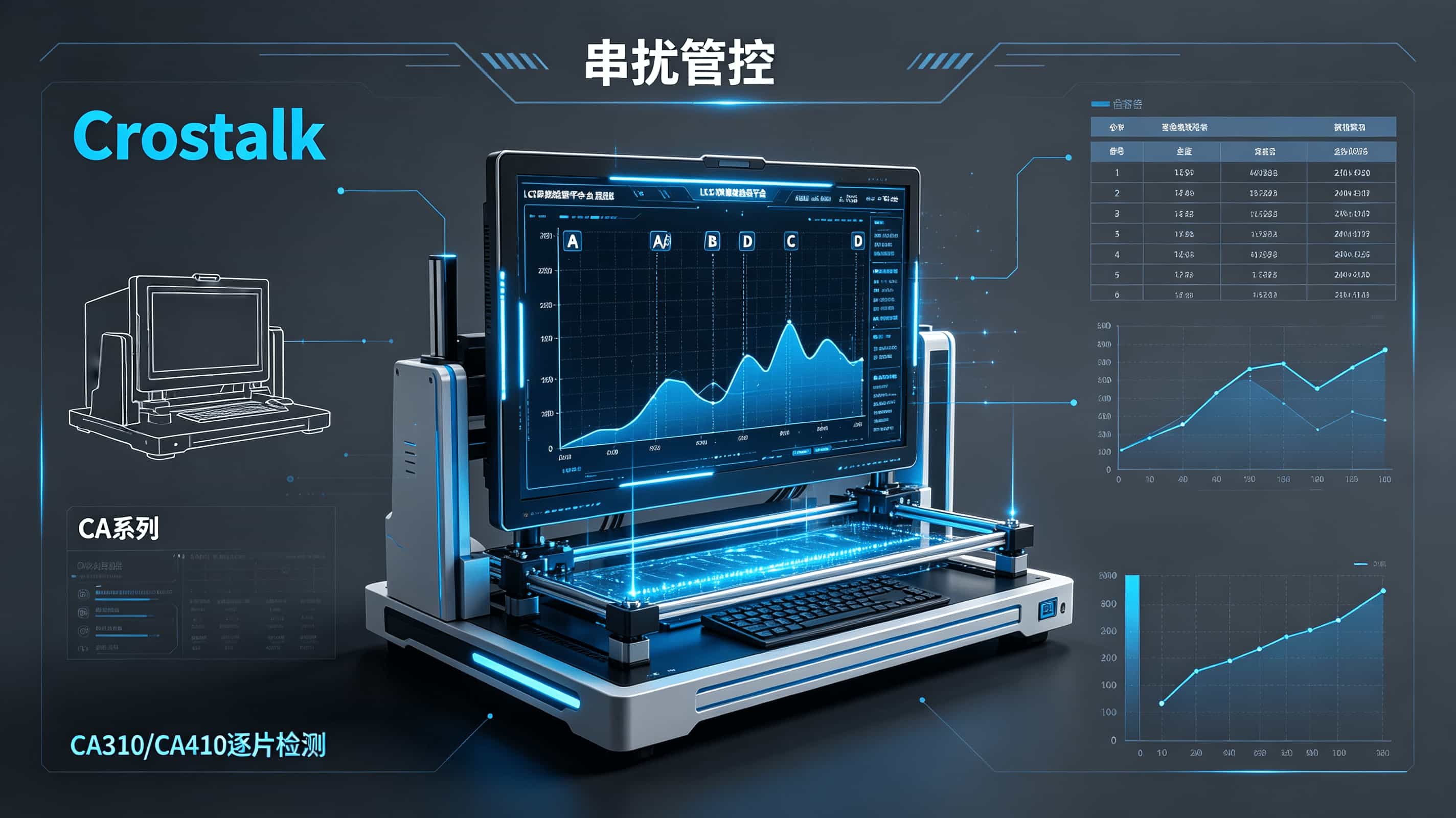
What does this number mean? It is to use professional equipment CA310/CA410 to test the brightness of points A/B/C/D on the screen. If the brightness difference exceeds 2%, it is judged as poor crosstalk.
And our internal control of 1.5% is stricter than this criterion, which is equivalent to adding an extra layer of insurance to the product.
From a technical perspective, there are four directions to address crosstalk:
Design to ensure that the distance between the data line and the pixel ITO is ≥ 6 μ m(What concept? One tenth of the diameter of the hair), increase the shielding layer, reduce the COM resistance, and make the line width of the Vcom ITO larger.
There are also solutions in the industry that offset coupling effects through pixel structure innovation (such as Huaxing's related patented technology), and we are continuously monitoring and following up.
Reduce the active layer area of TFT in the process and optimize the gate turn off voltage(usually set at around -10.5V), using a dual active layer or dual gate structure.
For example, in the thickness control of TFT active layer, the deviation exceeds± 0.5μm, The leakage current may exceed the standard. These may sound complex, but in other words, they aim to increase the precision of each production process.
Driver IC and AlgorithmOptimize Gamma binding point voltage, use dynamic VSP compensation algorithm, and 8K panel specific compensation algorithm. Algorithms, good and bad, can have a significant difference in effectiveness.
Assemble the whole machineFPC bending stress, internal electromagnetic environment, and high temperature and humidity environment may all induce secondary crosstalk. No matter how good the module is, it's useless if you don't pay attention to assembly.
4、 For terminal manufacturers, how to choose module suppliers without stepping on pitfalls?
Based on our years of experience dealing with clients such as monitors, laptops, and advertising machines,Here are four practical suggestions for you:
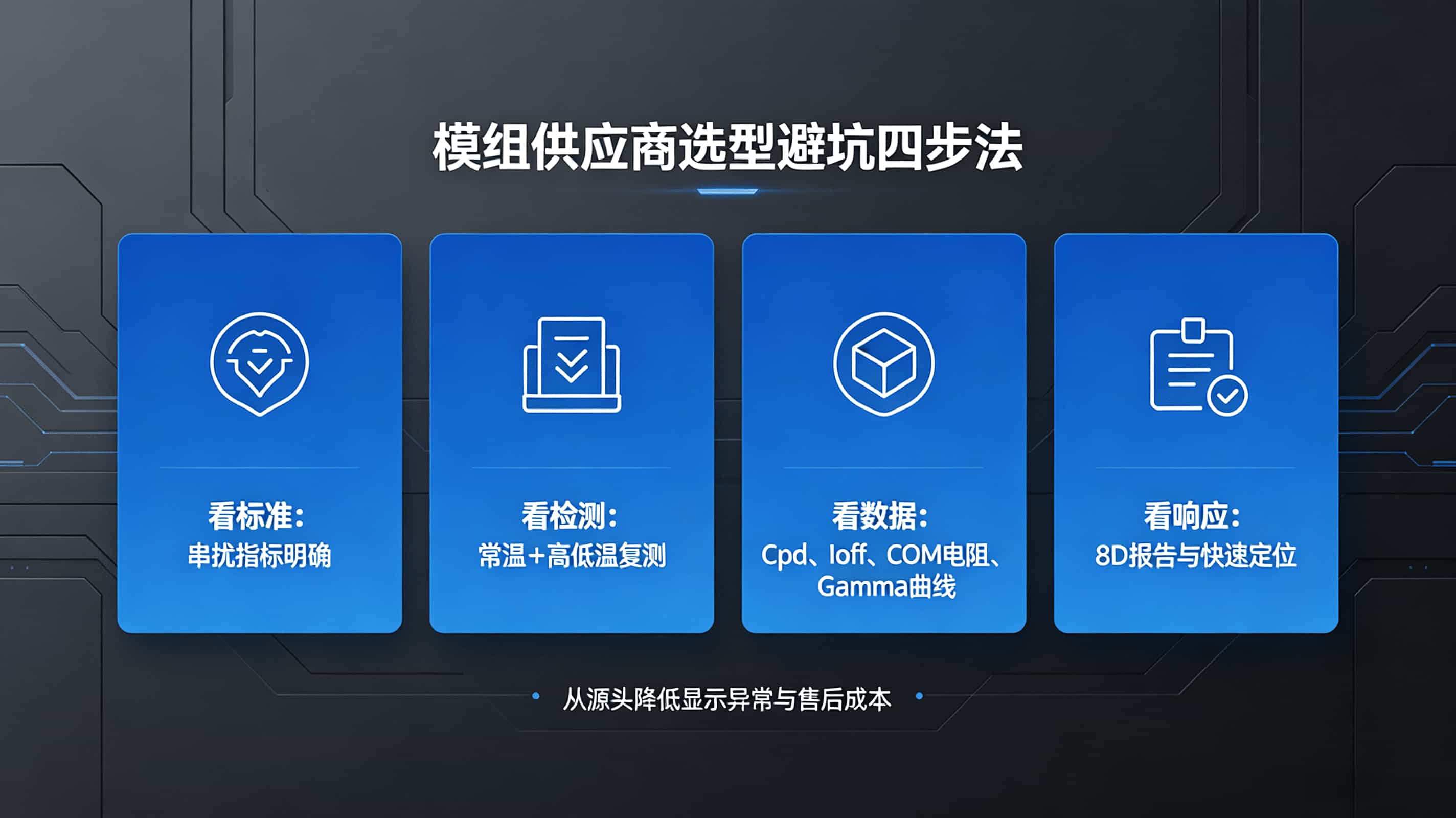
Firstly, look at the standards.What is the supplier's crosstalk standard. If the other party cannot provide specific numbers or the standard is more lenient than 3%, it is recommended to pass directly. Because suppliers with unclear standards have problems, you don't even have a basis for accountability.
Secondly, observe the testing process.A good module factory not only does individual testing, but also conducts whole machine level retesting. In the field of in car displays, reliability testing even needs to be conducted in high and low temperature environments.
Only measuring normal temperature without measuring high or low temperature can easily cause problems in winter and summer. Especially in the dry and cold winter environment in the north and the humid and hot summer environment in the south, when the temperature is extreme, the interference is exposed in its original form.
Thirdly, look at the data.Request suppliers to provide Cpd, Ioff measured data, COM resistance values, and Gamma curves. Data won't deceive people, those who dare to show you data have confidence in their hearts.
Fourth, evaluate the ability to handle problems.What should I do if something goes wrong? Do you have an 8D report? Can you quickly locate whether it's a problem with the Panel end or the driver end? These determine whether you will be passively beaten or quickly resolved after something happens.
We produce LCD display modules ranging from 10.1 inches to 32 inches during the competition,Mainly serving manufacturers of displays, laptops, advertising machines, and terminal equipment.
The size range of 10.1 to 32 inches has particularly high requirements for controlling crosstalk.The size is moderate, the pixel density is not low, and the user is watching up close, so even a small deviation cannot escape the eyes. Our investment in crosstalk control is precisely because this interval cannot be compromised.
From ensuring that the distance between the data line and the pixel ITO is ≥ 6 μ m during the design phase, to strictly controlling the parameters of the TFT active layer in the process, to using CA310/CA410 to test each piece before leaving the factory, the 1.5% standard is not arbitrarily set, but is gradually ground out from measured data.
To put it simply, module manufacturers and terminal manufacturers are partners on the same boat. If your product sells well, we will have continuous orders; Your product was returned due to screen issues, and we will also be affected.
So, if you are selecting LCD display modules or struggling with display quality issues with existing products,Feel free to contact us anytime.You can reply directly in the background of the official account“Crosstalk“One on one communication helps you avoid pitfalls.
Crosstalk is not mysticism, it is the reward for every detail being done properly.
A good screen is made by both parties together.
#LCD Screen # Crosstalk # LCD Display Module # Monitor # Display Panel # Screen Fault # Quality Control # TFT-LCD # Screen Crosstalk